White House defends Argentina team’s free speech over Falklands banner

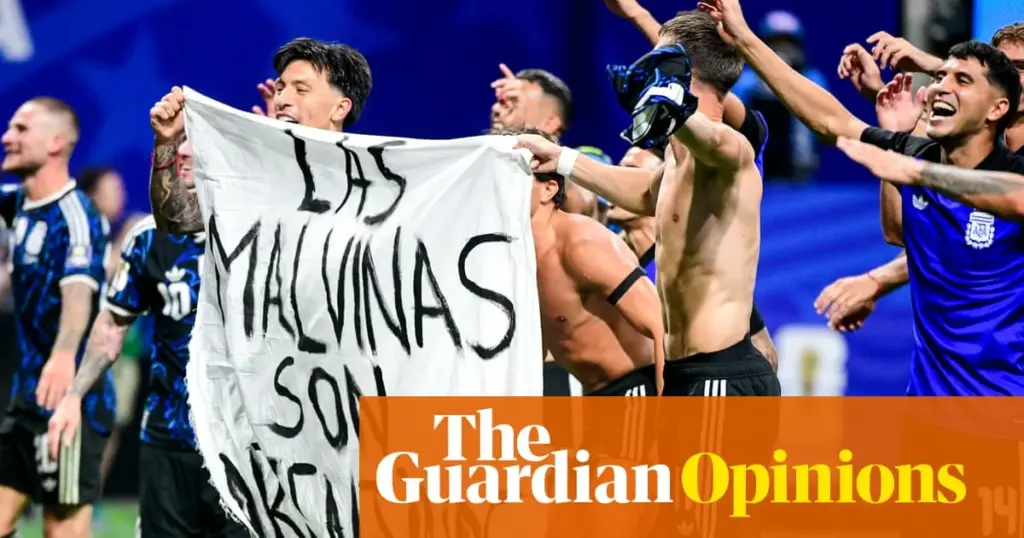
The White House has defended the Argentina national football team’s right to free speech after players displayed a controversial banner during their World Cup celebrations. The banner, which read “Las Malvinas son Argentinas” (The Falklands are Argentine), was shown after Argentina‘s semi-final match against England.
Andrew Giuliani, head of the White House Fifa task force, stated on Friday that the team had the opportunity to “make those statements” in the United States. He referenced US Constitution First Amendment rights, affirming the belief in these protections.
International Reaction to the Banner
The display of the banner has sparked a diplomatic row. Downing Street has supported calls for Fifa to investigate the incident. A spokesperson for the Prime Minister reiterated the UK‘s commitment to the Falkland Islands, stating, “The World Cup might not be ours, but the Falkland Islands definitely are. Our commitment to the Falklands will never waver.”
No 10 indicated that any potential action against the Argentina players is “a matter for Fifa” but echoed the sentiment that the governing body should investigate. The government of the Falkland Islands expressed disappointment, hoping Fifa would “sanction all behaviour of this nature in line with its own rules.” They also stated a desire for politics not to be brought into sport and for the islands not to be used as a “political football.”
Fifa‘s stadium code of conduct prohibits “banners, flags, flyers, apparel and other paraphernalia that are of a political, offensive, and/or discriminatory nature.” In 2014, Argentina was fined by Fifa for a similar banner display.
Historical Context of the Dispute
The Falkland Islands, a British overseas territory in the south-west Atlantic Ocean, remain the subject of a sovereignty dispute between the UK and Argentina. In 2013, a referendum saw Falkland Islanders vote overwhelmingly to remain a UK overseas territory, with 1,513 votes in favour and just three against, from 1,517 votes cast.
A brief conflict over the territory occurred in 1982, when Argentine forces landed on the Falklands. A British military task force subsequently ejected them. The 74-day conflict resulted in the deaths of 255 British military personnel, three islanders, and 649 Argentine soldiers.
Prior to the 1982 conflict, British governments had been involved in negotiations regarding the islands’ sovereignty with Argentina. A 1971 communications deal allowed islanders to travel and trade with the adjacent mainland, accessing facilities and schools. Hundreds of Argentinians also visited Port Stanley as tourists, fostering relations from which a future settlement was anticipated.
Argentina‘s Vice-President, Victoria Villarruel, posted on social media after the semi-final victory, stating, “It wasn’t just another match” and asserting, “The Falklands are Argentine.” She also noted that bringing such banners to the stadium was banned, but that the sentiment was deeply ingrained.
Argentina players have also been heard singing chants referencing the Falklands, along with Argentina football figures Maradona and Lionel Messi, following a victory in the last 16. Midfielder Rodrigo De Paul commented on these chants, saying they were to remember “Malvinas heroes” but acknowledged that the issue of the Falklands should be discussed elsewhere, separate from a football match.
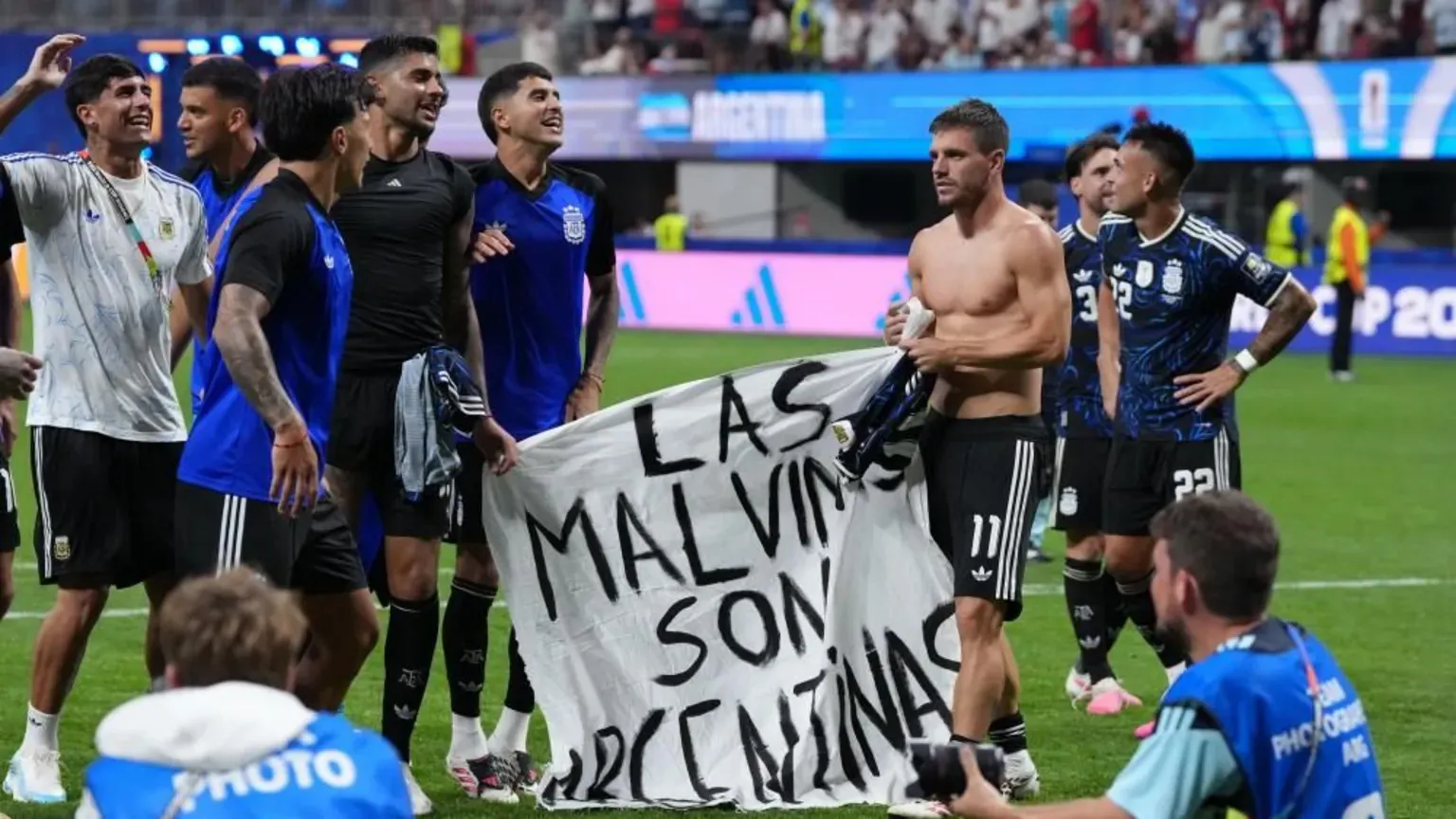
The Argentina team secured a win against England in the semi-final, with Lisandro Martínez and Giovani Lo Celso among the players holding the banner.
Read Also
Source: bbc.com

