England gymnast Gabriel Langton suffers fall at Commonwealth Games


England’s Gabriel Langton sustained an injury during the men’s team gymnastics final at the Commonwealth Games in Glasgow, an incident that overshadowed his team’s silver medal performance. The 19-year-old gymnast, representing the City of Birmingham Gymnastics Club, required extensive medical attention on the mat after a fall during the final rotation of the evening.
Langton fell headfirst to the floor after missing his catch on the horizontal metal bar, which is situated three metres in the air. This led to a significant delay in the competition as approximately a dozen medical staff attended to him. He was eventually transported from the arena on a trolley after being moved onto a stretcher, with his head and neck stabilised. The crowd offered a large applause as he departed, having observed the previous 10 minutes in silence.
Medical Response and Team Reaction
Before leaving the arena floor, Langton was observed to be conscious and moving his legs and arms. Team officials later confirmed that he was moving and communicating with doctors. Team England issued a statement expressing gratitude to the medical teams for their immediate assistance, adding that Langton had been taken to hospital and further information would be provided when available.
The incident occurred while England was in a close contest with Canada for the team title. At the time of the stoppage, Canada held a narrow lead over England, with Australia in the bronze-medal position. Scotland was close behind in fourth, followed by Cyprus in fifth and Wales in sixth.
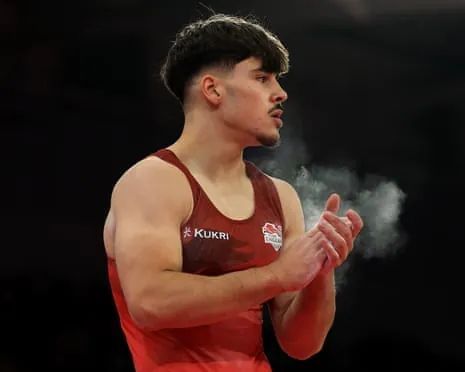
Following Langton’s fall and the subsequent delay, teammate Luke Whitehouse was the first to compete on the same apparatus. He scored 11.700, a relatively low score, and later commented on the difficulty of performing after such an event. Whitehouse stated that gymnasts must try to forget about such incidents and reset, focusing on their routine one skill at a time. He also mentioned that from what the team had heard, Langton was doing “OK.”
Whitehouse emphasised the inherent dangers of gymnastics, noting that such events serve as a reminder of the sport’s risks. He described it as something that gymnasts must try to put out of their minds to continue competing.
Competition Resumes
After the competition resumed, England’s team was unable to overcome Canada’s lead. Canada secured their first gold medal in the event in 20 years, having previously finished second to England in the past two Games. Langton, who was a late call-up to Team England in place of the injured Max Whitlock, was not able to join his teammates on the podium to receive their silver medals.
Felix Dolci, a member of the gold-winning Canadian team and a leading qualifier for the all-around competition, acknowledged the severity of the situation. He described gymnastics as a very difficult and complicated sport, highlighting its dangerous nature at times. Dolci extended thoughts to Gabriel and the English team, commending England for maintaining focus and staying in the zone despite the challenging circumstances.
Dolci also noted that seeing such an incident is difficult for any gymnast on the field of play and is something no one wishes to witness, further illustrating the demanding nature of the sport. Hamish Carter from Team Scotland, whose team narrowly missed out on a bronze medal to Australia in the final rotation, stated he did not see the fall but was relieved to hear Langton was alright, reflecting on the potential for serious injury.
England ultimately finished with a score of 238.250. Canada secured the gold with a total of 241.400, with René Cournoyer scoring 13.500 and Dolci contributing 13.700 in their final routines. Australia claimed the bronze medal with 235.650, fending off Scotland’s late challenge, who finished fourth with 234.300. Cyprus placed fifth with 228.350, and Wales finished sixth with 227.000.
Whitehouse had started strongly with a score of 14.400 on the floor exercise. However, England was in fourth place behind Canada, Australia, and Cyprus after three rotations, with Canada leading on 122.200 points. England then began to close the gap as Australia faced difficulties on the high bar. Alexander Yolshin-Cash played a significant role in England’s resurgence, achieving the highest parallel bars score of the evening with 14.100.
Canada’s lead briefly appeared vulnerable when Cournoyer scored 11.550 after coming off the high bar, allowing England to reduce the deficit. However, Dolci then delivered the highest score on that apparatus for the night, 14.250, to maintain Canada’s advantage heading into the final rotation. England responded well after Whitehouse’s slight stumble, with Yolshin-Cash performing another strong high bar routine, scoring 13.250, which secured his qualification for the individual final.
Scotland also made a late push for bronze, with Cameron Lynn scoring 13.500 on the high bar and Hamish Carter adding 12.350. Reuben Ward then scored 13.150. Despite a strong performance from Connor Sullivan in the final routine, Scotland fell short by 1.350 points, as Australia’s consistency on the pommel horse proved decisive.
The incident occurred on 24 July 2026.
Read Also
Source: bbc.com

